

Medical Dermatology · Acne, Rash & Cyst Care
Acne, Rashes, and Cysts: Common Conditions That Deserve an Accurate Diagnosis
These are three of the most common reasons patients see a dermatologist, and three very different conditions. Here's what causes each one and how they're actually treated.
Reviewed by Dr. Sam Abaza. Diplomate, American Board of Physician Specialties
5 min read · 6 scientific references
85%
of adolescents are affected by acne, and it often persists into adulthood, especially in women. American Academy of Dermatology.
50 million
Americans affected by acne each year, making it the most common skin condition in the country. American Academy of Dermatology.
7.6%
of U.S. adults have atopic dermatitis (eczema), one of the most common causes of persistent rash. National Health Interview Survey, JAAD.
2.8%
recurrence rate for cysts removed with complete surgical excision, versus much higher rates for incision and drainage alone. Clinical study.
What causes acne, rashes, and cysts?
Acne develops when hair follicles become clogged with oil and dead skin cells, creating an environment where bacteria can trigger inflammation, resulting in whiteheads, blackheads, or deeper inflamed breakouts. It's driven by a combination of genetics, hormones, and follicle behavior, which is why it often flares during puberty, hormonal shifts, or stress, and why treatment usually needs to address more than one contributing factor at once.
A rash is a general term for irritated, inflamed, or changed skin, and its causes vary widely. Eczema (atopic dermatitis) is a chronic inflammatory condition tied to a compromised skin barrier and immune response. Contact dermatitis develops when skin reacts to something it directly touched, like a soap, fragrance, or plant. Psoriasis is an autoimmune condition causing rapid skin cell turnover. Because these causes are different, accurate diagnosis matters more for a rash than almost any other common skin concern, since the right treatment for one type can be ineffective, or even worsen, another.
A cyst, most commonly an epidermoid or sebaceous cyst, forms when keratin, a protein normally shed from the skin's surface, becomes trapped beneath the skin instead, forming a slow-growing, usually painless pocket. Cysts are benign in the vast majority of cases but don't resolve on their own and typically continue growing slowly over time.
When you should schedule a visit:
-
Acne that isn't improving with over-the-counter products after 8 to 12 weeks of consistent use.
-
A rash that's spreading, worsening, or not responding to basic care like moisturizer or avoiding a suspected trigger.
-
Any rash accompanied by fever, blistering, or signs of infection, which warrants prompt evaluation.
-
A cyst that's growing, becoming painful, or showing signs of infection like redness and warmth.
-
Any new or changing skin growth you're unsure about, since accurate diagnosis is the first step for all three conditions.
-
Symptoms that are affecting your confidence or quality of life, since effective treatment exists for all three conditions.
Acne, Rash, and Cyst: How to Tell Them Apart
These three conditions can sometimes look similar to an untrained eye, especially in early stages, but they behave very differently and require different treatment approaches. Here's a general comparison, though an in-person exam is always the most reliable way to know what you're actually dealing with.
Acne vs. Rash vs. Cyst at a Glance
Factor | Acne | Rash | Cyst |
|---|---|---|---|
Appearance | Whiteheads, blackheads, or inflamed bumps | Redness, irritation, scaling, or itching, varies by cause | Smooth, round, slow-growing lump under the skin |
Common cause | Clogged follicles, hormones, bacteria | Eczema, contact irritants or allergens, psoriasis, infection | Trapped keratin beneath the skin |
Typical onset | Gradual, often tied to hormonal changes | Can appear suddenly, especially with contact dermatitis | Very gradual, often unnoticed until it grows |
Pain level | Can be tender if inflamed | Often itchy rather than painful | Usually painless unless infected |
Resolves on its own? | Individual breakouts may, underlying tendency usually persists | Depends on cause; chronic conditions like eczema recur | No, cysts typically continue growing slowly |
Primary treatment | Topical or oral medication, tailored to severity | Identify and address the underlying cause | Surgical excision if bothersome or growing |
When should each condition be treated professionally?
Acne warrants professional treatment when over-the-counter products haven't helped after 8 to 12 weeks, or when breakouts are inflamed, painful, or leaving marks or scarring behind. A rash warrants evaluation any time it's spreading, worsening, not responding to basic care, or accompanied by symptoms like fever or blistering, since accurate diagnosis is essential to choosing the right treatment. A cyst doesn't require urgent treatment unless it becomes painful, infected, or is growing, but many patients choose to have a bothersome cyst removed electively once it's confirmed benign.
Dr. Abaza's Recommendation
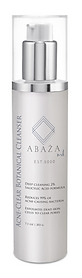
For patients managing active breakouts, a consistent, gentle cleansing routine makes a meaningful difference alongside any prescribed treatment.
How are acne, rashes, and cysts actually treated?
Acne treatment is tailored to severity and can include topical retinoids, benzoyl peroxide, topical or oral antibiotics, hormonal treatments, or oral isotretinoin for more severe cases, often used in combination rather than as a single product. Rash treatment depends entirely on the underlying cause, once identified, options range from avoiding a specific trigger to topical steroids, barrier-repair moisturizers, or systemic treatment for more significant inflammatory conditions. Cyst treatment is surgical: complete excision of the cyst wall is the only approach that reliably prevents regrowth, since incision and drainage alone leaves the cyst wall in place and carries a meaningfully higher recurrence rate.
Why won't my acne go away with over-the-counter products? Over-the-counter products often address only one contributing factor, like surface bacteria or oil, while acne is typically driven by multiple factors at once, including hormones and follicle behavior. A dermatologist can combine treatments that address several causes simultaneously, which is often necessary for meaningful improvement.
Is it safe to pop or drain a cyst myself? No. Draining a cyst at home doesn't remove the cyst wall, which means it will very likely grow back, and there's a meaningful risk of introducing infection. Professional excision removes the entire cyst wall, which is what actually prevents recurrence.
How do I know what kind of rash I have? Many rashes look similar to the untrained eye but have very different causes and treatments. An in-person exam, and sometimes patch testing for suspected contact allergies, is the most reliable way to get an accurate diagnosis rather than guessing based on appearance alone.
Can acne scarring be treated? Yes. Depending on the type and depth of scarring, options include microneedling, chemical peels, or laser treatments, all of which are available at DermeSurge. The right approach depends on your specific scarring pattern and skin type.
Is cyst removal covered by insurance? Cyst removal is often covered when it's medically necessary, such as when a cyst is painful, infected, or rapidly growing. Purely elective removal of an asymptomatic cyst may not be covered. Our office can help verify your specific benefits ahead of the procedure.
Sources Cited in This Page
1. American Academy of Dermatology. Updated guidelines for the management of acne vulgaris, 2024.
2. Prevalence of atopic dermatitis in the United States from 2021 to 2024. Journal of the American Academy of Dermatology, National Health Interview Survey data.
3. Comparison of the Surgical Outcomes of Minimal Excision and Elliptical Excision Techniques in Treating Epidermal Inclusion Cysts. Clinical study.
4. Surgical Excision Versus Incision and Drainage for Epidermoid (Sebaceous) Cysts: A Systematic Review. Cureus.
5. Cleveland Clinic. Epidermal Inclusion Cysts (Sebaceous Cysts): Treatment & Causes.
6. Zuber TJ. Minimal excision technique for epidermoid (sebaceous) cysts. American Family Physician.
This page is for general educational purposes and does not replace an in-person medical evaluation. Diagnosis and treatment recommendations depend on an in-person exam and your specific history. Schedule a consultation with Dr. Abaza to discuss your specific concern.
Bottom Line
Three Common Conditions, Three Different Treatment Paths
Acne, rashes, and cysts are three of the most common reasons patients see a dermatologist, and each one requires a different treatment approach based on an accurate diagnosis. Guessing based on appearance alone often leads to the wrong treatment. A consultation with Dr. Abaza is the fastest way to know exactly what you're dealing with and the treatment plan that will actually work.